
The specialist defines the irrigation rules
Mode, periods, thresholds, dose, minimum intervals, technical starts, calibration, and the Safety schedule are reviewed for a specific zone.
Professional irrigation
Configure time slots, accumulated-radiation rules, calibration, and a local Safety schedule in one production workflow. Gros.farm calculates and sends reviewed configuration; the local node executes it at the facility.
A controlled irrigation workflow
The production team defines and approves the irrigation strategy. Gros.farm organizes the configuration and history. The local node controls pumps and valves and keeps the agreed backup behavior available on site.
Mode, periods, thresholds, dose, minimum intervals, technical starts, calibration, and the Safety schedule are reviewed for a specific zone.
Rules are connected to the facility, zone, active crop cycle, stage, data source, and approval history.
The control node executes starts, controls the connected outputs, and follows its local Safety configuration when cloud data is unavailable.
Irrigation modes and controls
Every mode needs a clear purpose, correct source data, calibrated delivery, and a local fallback agreed with the engineering owner.
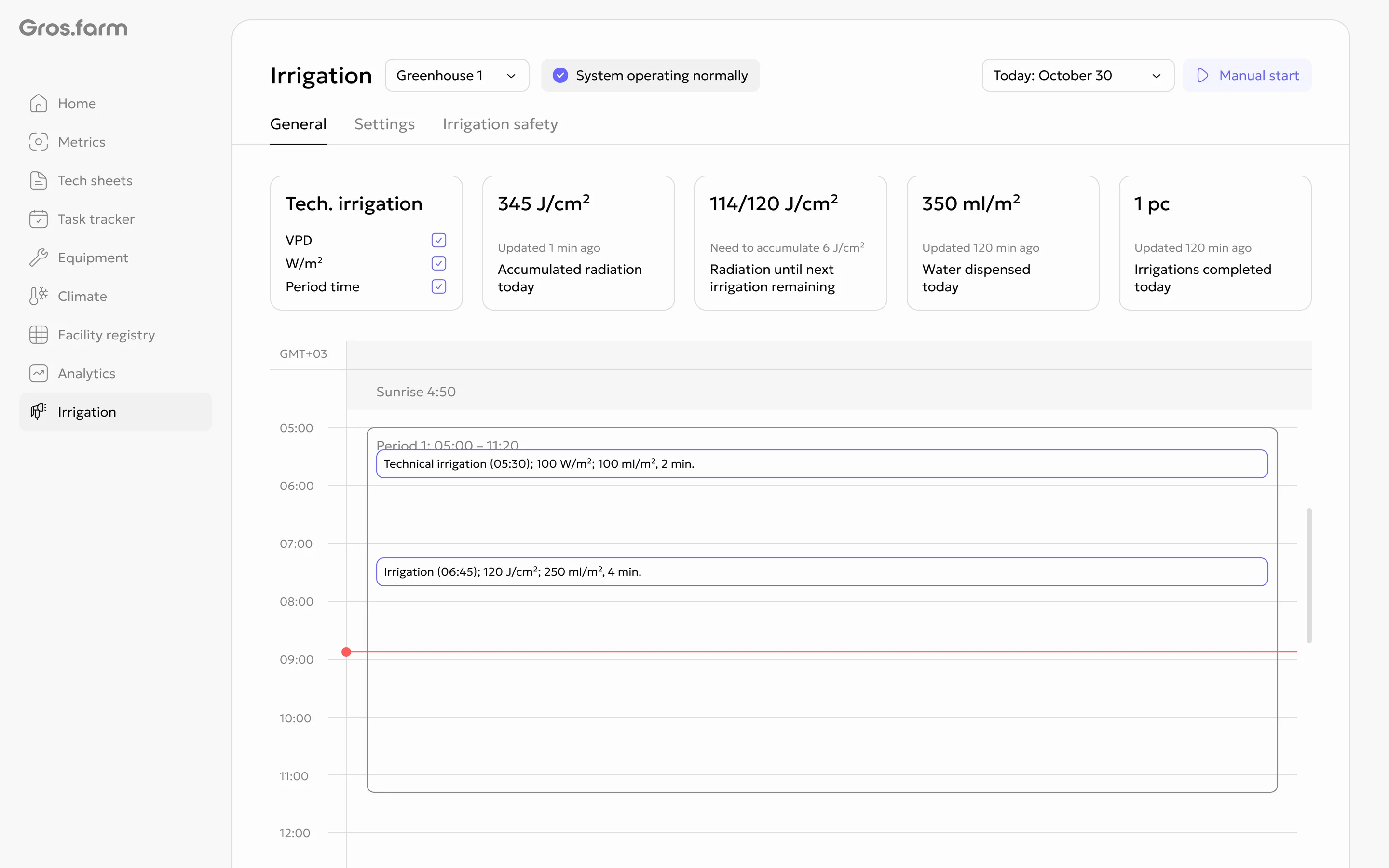
Review the selected greenhouse and date, system status, accumulated radiation, water delivered, and planned or completed runs.
Set operating windows and doses for work that should begin at a defined time regardless of accumulated radiation.
Use an approved threshold, time window, minimum interval, and correctly configured radiation data source.
Link measured outlet flow, outlet count, and zone area before relying on volume-based doses.
Where configured, combine defined conditions such as radiation, VPD, substrate temperature, and an allowed window.
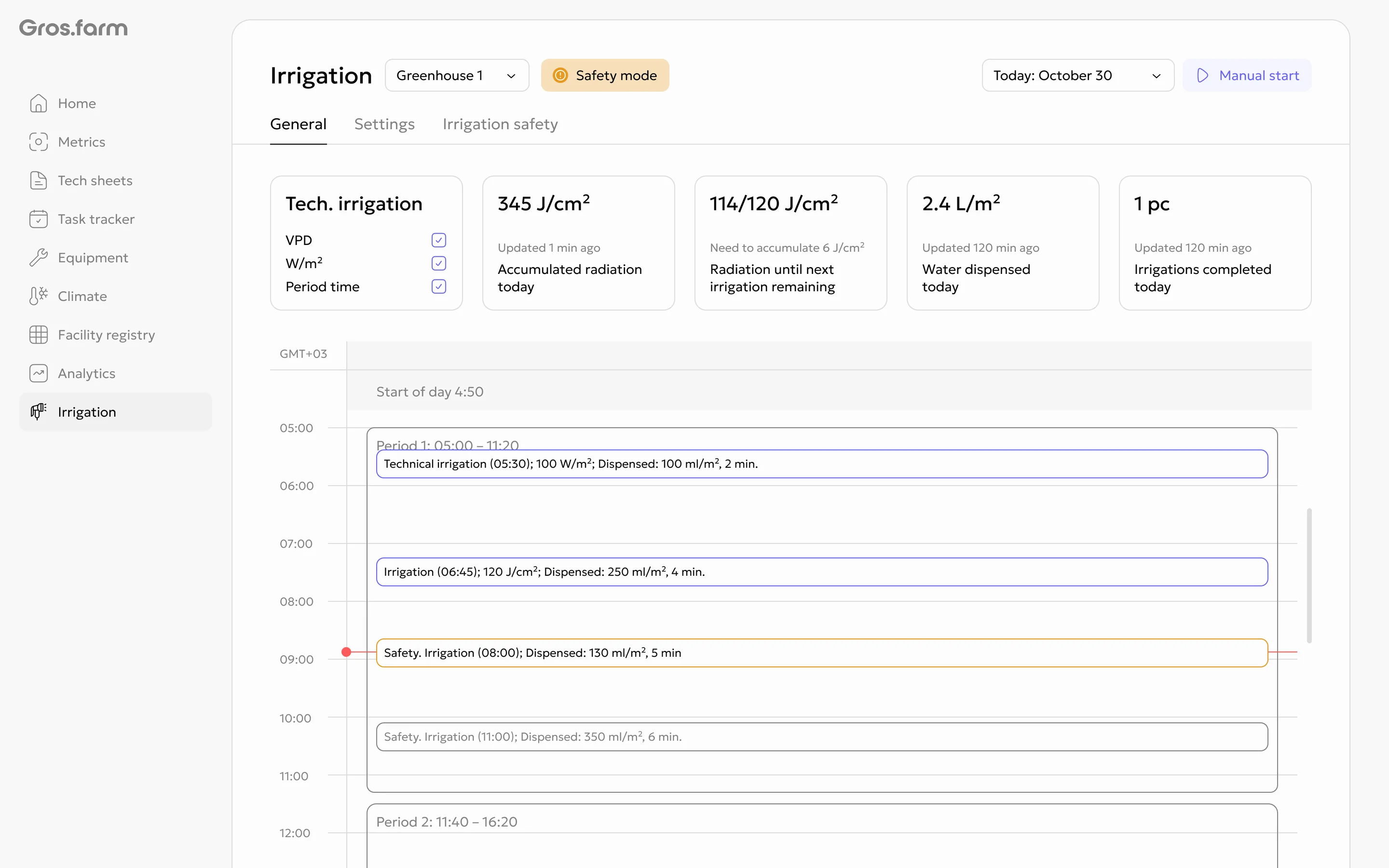
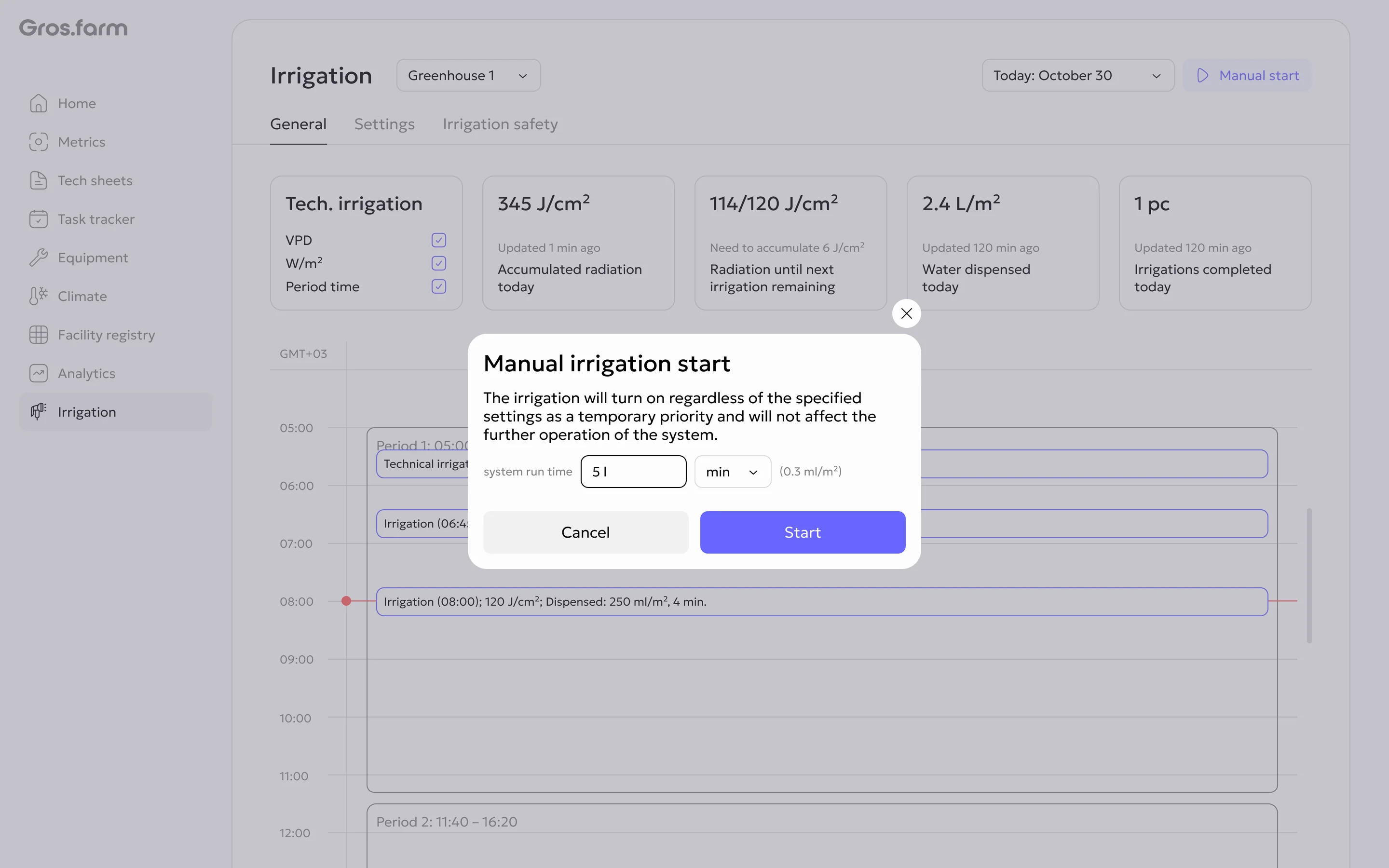
Keep a simplified local Safety schedule and use manual start or stop only after checking the selected zone and actual site state.
Configuration path
Entering values is not the same as activating them. The configuration becomes operational only after review and explicit application.
Check the control node, connected pumps and valves, zone mapping, local interlocks, and responsible engineering owner.
Confirm units, update frequency, availability, and the correct radiation or sensor source for the selected zone.
Measure actual flow and enter the outlet count and zone area before setting doses by volume.
Set time slots or radiation periods, doses, thresholds, windows, and minimum intervals.
Define the simplified local behavior for lost connectivity or unavailable data without replacing emergency protection.
Explicitly apply the configuration, then compare planned and actual starts and verify the equipment state on site.
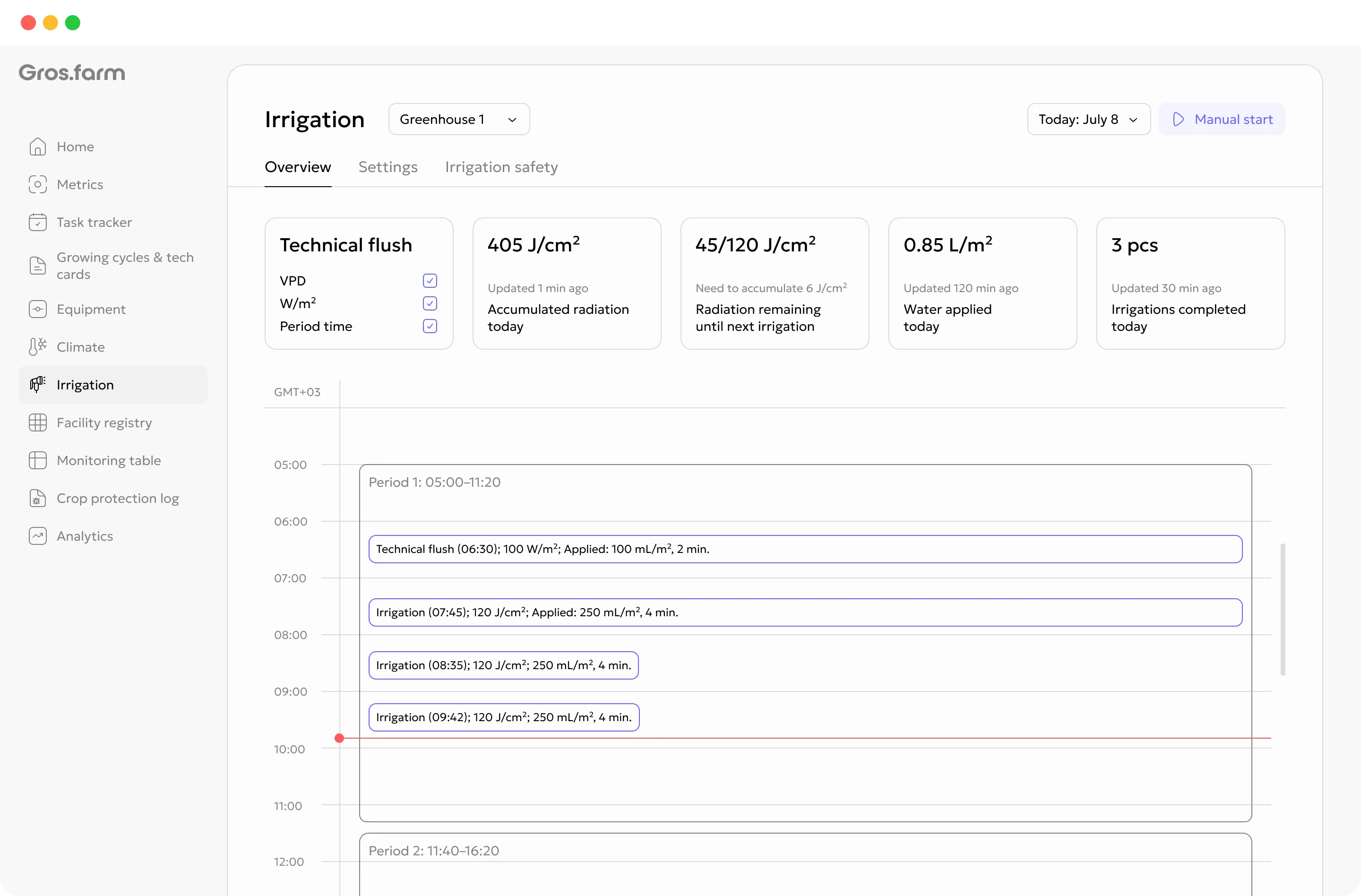
English product screens
The overview explains what the system planned and recorded. It is an operational information surface—not proof of the physical equipment state by itself.
Responsibility boundary
Gros.farm can calculate and transmit an approved strategy, but it does not replace the local controller, emergency automation, equipment protection, or the responsible specialist.
Prepare a pilot zone
A good pilot begins with one zone whose equipment, flow, data sources, and operating responsibility are understood.
Show the local node, pumps, valves, outlets, dosing equipment, zones, and existing interlocks.
Prepare outlet-flow measurements, zone area, outlet count, radiation source, and available sensor details.
Have the agronomy and engineering owners review the intended mode, limits, fallback, and observation period.
Questions before implementation
Solar energy is accumulated over time. When the reviewed threshold is reached within the allowed window and the minimum interval has elapsed, the system schedules the next run. The local node physically operates the equipment.
Yes. Time-slot mode starts irrigation at specified times with a dose set by duration or, after calibration, by volume. Time slots and radiation periods can serve different purposes in the same daily strategy.
The local node follows its configured Safety schedule. This is a simplified fallback and does not replace hardware protection, emergency logic, or the facility’s standard operating procedures.
No. Gros.farm organizes and sends reviewed configuration and keeps production history. The local controller or node remains responsible for physical equipment operation and safety.
Calibration is required before a duration can be treated as a reliable delivered volume. Measure the actual outlet flow and verify the outlet count and zone area.
Where manual control is available, a user can issue a temporary command after confirming the zone and operation. The actual site state and safety must be checked before any manual action.
The responsible agronomy and engineering specialists do. Gros.farm applies the reviewed configuration but does not make the agronomic or safety decision on their behalf.
Start with the actual facility
Show us the production area, current system, responsible roles, and the result you want. We will help define a practical first phase.