The existing system remains in place
Controllers, climate computers, sensors, dosing units, weather services, and other sources continue to serve their current role.
Automation integrations
Bring data from local automation, climate computers, sensors, solution units, and external services into Gros.farm without replacing the existing engineering infrastructure.
From signal to production meaning
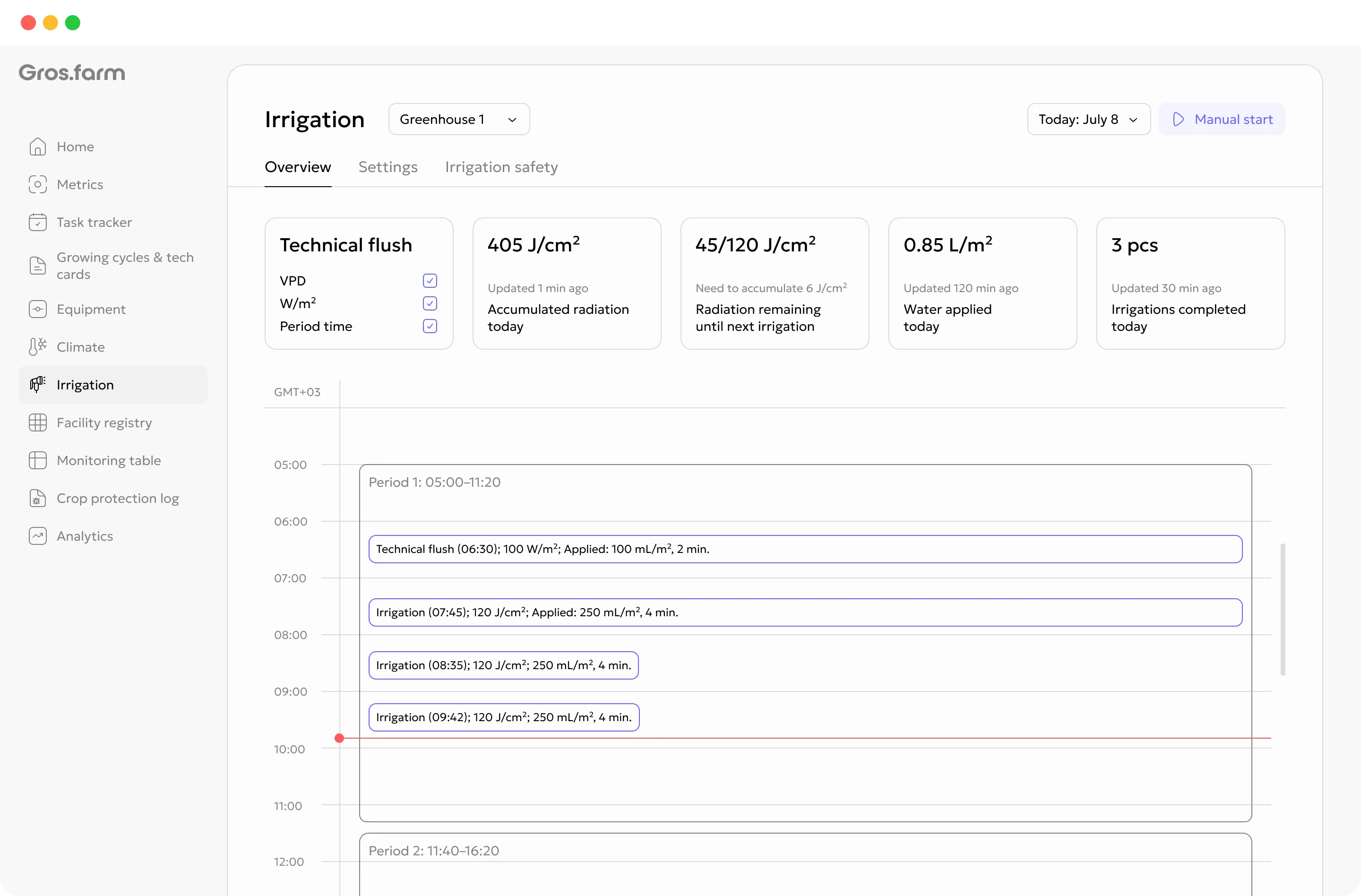
A temperature value or controller event is not enough on its own. Gros.farm connects it to a facility, zone, crop cycle, stage, target, task, and period so the production team can interpret it.
Controllers, climate computers, sensors, dosing units, weather services, and other sources continue to serve their current role.
Use an available API, industrial protocol, gateway, file exchange, or supported local node for an agreed set of signals and commands.
Data is mapped to the correct facility, zone, metric, crop cycle, cultivation-plan stage, and responsible workflow.
Integration patterns
Not every project needs writable control. Many farms gain value by first validating read-only data, units, and production mapping.
Collect approved signals, states, events, and historical values for monitoring, comparison, and analytics.
Where supported, transmit approved targets or schedules through a defined interface with clear responsibility and limits.
Keep the current control program while adding crop-stage context, target comparison, and shared production history.
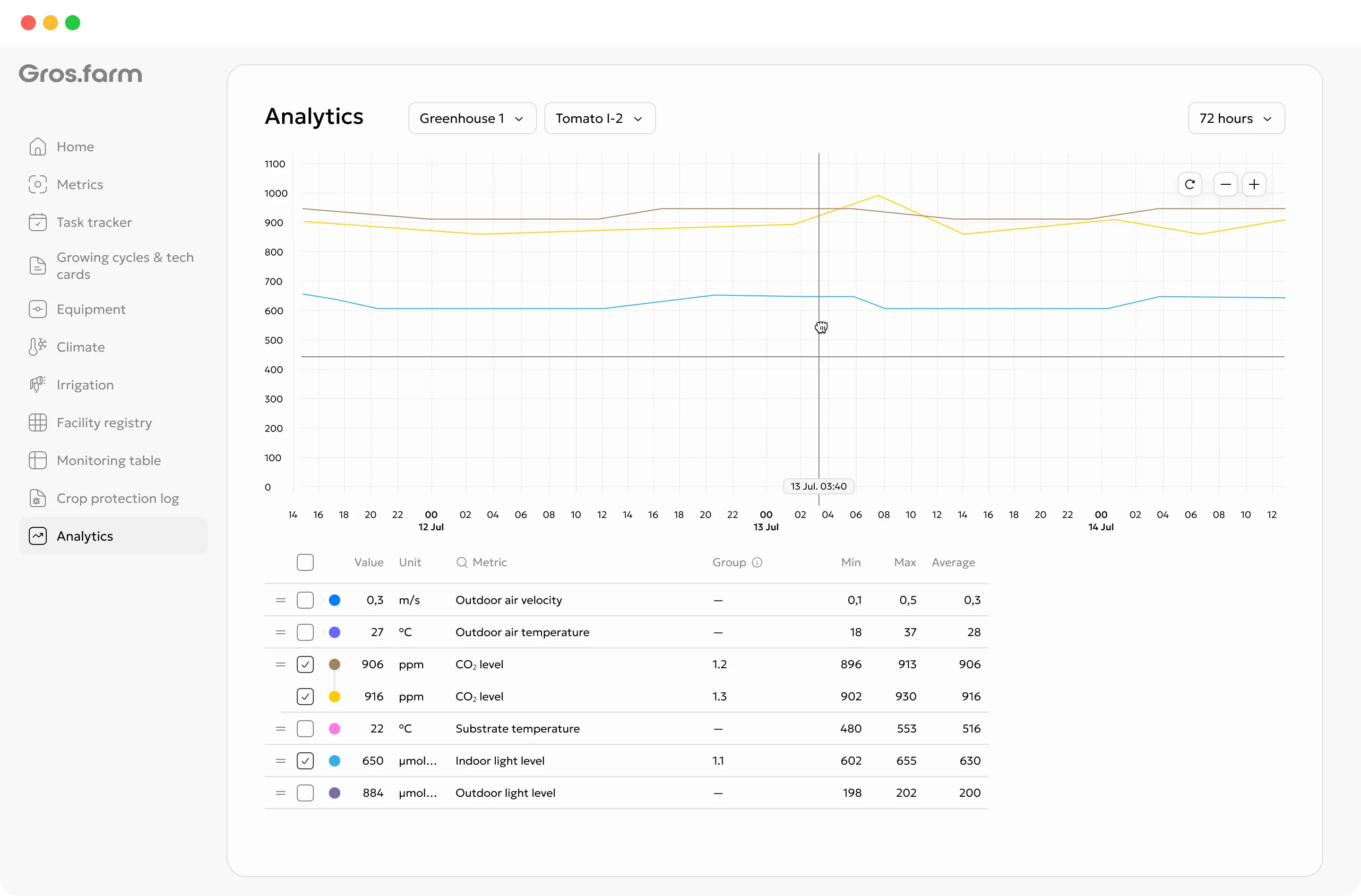
Map climate, substrate, light, CO₂, EC, pH, water, and other available data to the correct facility and metric.
Connect available recipe, tank, line, EC, pH, flow, and delivery information to irrigation and crop history.
Use supported services or structured imports when they improve a defined production workflow.
Integration assessment
The best interface is the one that safely delivers the required data or action with the least unnecessary complexity.
Provide model names, a diagram, interface documentation, or a short video of the actual controller and process.
Agree what the team needs to see or do, for which facility, crop process, and responsible role.
Choose the required readings, states, events, targets, or commands instead of copying every available tag.
Validate protocols, units, update frequency, permissions, writable boundaries, interlocks, and failure behavior.
Connect each signal to the correct facility, zone, metric, crop cycle, and reporting context.
Start read-only where practical, compare the interface with the actual site, and expand only after the result is trusted.
What connected data enables
Once data is mapped correctly, the team can review it beside crop targets, irrigation events, tasks, observations, and production results.
Responsibility boundary
Gros.farm operates above local automation. The local engineering system remains the source of physical reliability, protective behavior, and safe operation.
Prepare an assessment
The same controller can be wired, programmed, and exposed differently at two facilities. Bring information about the actual installation.
Prepare models, firmware where relevant, protocols, gateways, APIs, export formats, and network constraints.
Identify the data to read, any settings to write, their units, owners, limits, and required failure behavior.
Choose a measurable result such as climate history for one block or irrigation status for one zone.
Questions before implementation
No. The objective is to connect the useful data and, where appropriate, reviewed settings while preserving the current local control and safety architecture.
Yes. Read-only access is often the best way to validate signal quality, units, mapping, and operational value before considering any writable integration.
Compatibility is confirmed for the actual installation. It depends on the controller model, program, protocol, gateway, available interface, permissions, and facility configuration.
Sensors may connect through a supported local node, controller, gateway, API, or another agreed source. The correct path depends on the device and facility architecture.
Where the interface is supported and the responsibility boundary is agreed, Gros.farm can send reviewed setpoints, schedules, or configuration. Local interlocks and safety logic remain authoritative.
The local system should continue according to its local program and protective scenarios. Synchronization, remote configuration, and some analytics may be temporarily unavailable.
Start with the actual facility
Show us the production area, current system, responsible roles, and the result you want. We will help define a practical first phase.